An economic profile of Blanchard
By Tony Strickland, Staff Writer
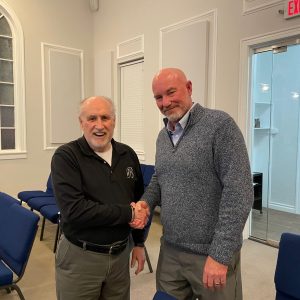
Brent Kisling, a partner in the Owasso-based firm of Retail Attractions, LLC, stepped before the city council on July 14th to deliver a brief presentation. What followed was a fascinating and eye-opening economic report on Blanchard and the surrounding areas from a professional and reasoned source.
First a little background: Retail Attractions is an economic development consulting firm that was hired a year ago by the City of Blanchard to communicate the strengths and needs of our growing city and the surrounding areas to potential business relocations, big and small. The firm first had to analyze those strengths and needs, hence the evening’s presentation and a blunt, exciting statement from Kisling to the council: “Our studies show that Blanchard is where the money is. We are telling business that this is the market they want to be in.”
The presentation centered on cities and communities within a 20-mile radius of Blanchard, then narrowed to target Blanchard itself. The 20-mile radius includes Bridge Creek, Norman, Middleberg, Chickasha, Goldsby, Noble, Moore, Mustang, Tuttle and Newcastle.
Kisling placed the population within that 20-mile radius at an estimated 448,574 people, with Blanchard serving as home to some 9,686 of those individuals.
The study showed the median age in the city as 37.9 (as opposed to the 20-mile average of 35.7) and, more revealingly, the average annual household income in Blanchard as $124,503, as opposed to the 20-mile figure of just $78,455 and $94,000 statewide. Average household net worth for our city? $1,183,587 (as opposed to the 20-mile of $912,219.)
Our average household size is 2.6, in line with the larger area average of 2.5. The vacant housing figure for Blanchard is just 4.9%, compared with 5.8% across the larger area. The average job commute for Blanchard residents is 29.6 minutes, while the median age of city homes is 30.4 years. Median rent in Blanchard is actually lower than the 20-mile average at $773 monthly as compared to $947 (and $1,007 statewide). The firm calculated total annual retail spending in the 20-mile area at $8.72 billion. Blanchard represents a healthy $208.06 million of that number.
On to the retail needs of our 20-mile radius as presented by Retail Attractions after their professional study (which does include sales from online companies like Amazon. For sure. I asked.)
Clothing and accessories (shoes, jewelry, luggage, etc): $252.41 million in sales currently with a total market potential of $540.84 million. That’s a big gap of $288.43 million in unmet market potential. That’s a lot of green. Hang on, there’s more.
Furniture and home goods? A $288.07 million gap. Electronics and appliances? A $460.18 million gap. Building and gardening? A smaller gap, but still sizable at $168.6 million. Food and beverages? There’s no gap for convenience stores, we’re really good there, but for grocery, meat market, seafood, fruits and veggies, liquor and the like? The gap is $342.99 million.
The health/personal care gap is a bit smaller at $91.85 million, while sporting goods/hobby needs are actually being met and then some: a sales market of $577.32 million against a potential market figure of $545.36 million (but sales potential is still there in the areas of sewing, bookstores and musical instruments).
The general merchandise market for the 20-mile is telling: We’re good on department stores, but superstores? Sales are $508.66 million. Sales potential? $953.99 million. That’s a $445.33 million gap. Walmart and/or Target, your move, guys. Here we are.
Miscellaneous stores (florists, office supplies, gifts, pet supplies, etc.): A $71.56 million gap. But no gap on mobile home sales. That market is saturated in the 20-mile ($4.58 million potential as opposed to sales of $5.25 million.) In central Oklahoma. No kidding. We ain’t scared.
Almost done. Food service and accommodation needs are a little uneven in the 20-mile. We’re well-supplied on limited-service restaurants, but there is need for full-service restaurants (a $130 million gap). There’s need for catering, drinking places and RV parks as well. Hotels are also a growth industry in the area with sales at $38.06 million and potential sales estimated at $60.26 million.
And finally, Kisling noted that gas station sales in the 20-mile are at $246.52 million, while the potential market is a burgeoning $354.91 million. Motor vehicle needs are divided. According to the presentation, we’re good on recreational vehicle dealers, on motorcycle/boat dealers, new car dealers and auto parts stores. There is, however, limited need for used car dealers (a $7.21 million gap) and tire dealers (a $7.98 million gap).
That’s the info that Retail Attractions has gathered about us, at least as much as was shared at the council meeting. The main takeaway for business-minded folks? There’s good money around these parts waiting to be spent (or made. However you want to see it.) More businesses mean more sales tax. More sales tax brings improved infrastructure and improved quality of life. And those two things bring more folks to call Blanchard home. Something to think about, for sure. Heck, if we get ourselves a Walmart and a Chick-fil-A, some of us will never have to leave town again.